
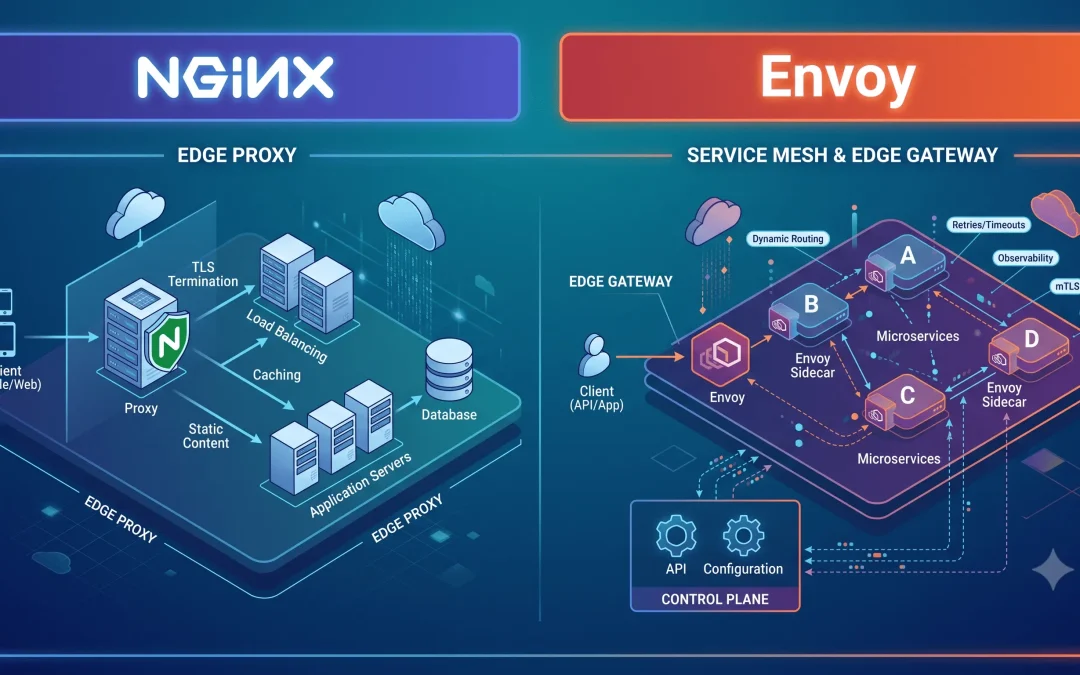
When building a web application or a distributed system, the proxy sitting between clients and your services can handle much more than forwarding HTTP requests. It can terminate TLS, route traffic, balance requests across services, collect telemetry, and help control how applications communicate.
Envoy and NGINX are two widely used options for these tasks. They overlap in several areas, but their design priorities are different. Understanding how each one is typically used makes it easier to decide where they fit in an architecture.
What Is NGINX Used For?
NGINX is commonly placed at the edge of an application. A request from a browser, mobile application, or external API client can reach NGINX before being forwarded to an application server.
A typical setup might look like:
Client → NGINX → Application → Database
In this arrangement, NGINX can handle tasks such as TLS termination, request routing, load balancing, compression, caching, and serving static files.
For example, an application might have separate frontend and backend services. NGINX can route requests based on the requested path:
- / → frontend application
- /api/ → backend API
- /assets/ → static files
This approach can keep routing logic at the edge instead of putting all of it into the application itself.
NGINX can also distribute requests across multiple application instances. If an API is running on several servers, NGINX can act as the load balancer between them.
What Is Envoy Used For?
Envoy was designed around the needs of distributed applications. It can be deployed as an edge proxy, API gateway, or as a proxy between services.
A simplified microservices architecture could look like:
Client → Envoy → API → Service A → Service B
In a service-to-service environment, Envoy can provide a consistent place to manage traffic policies. These can include timeouts, retries, routing rules, health checks, and other traffic controls.
Envoy is also closely associated with service mesh architectures. In that model, proxies are deployed alongside application services, allowing traffic between services to be managed without requiring every application to implement the same networking features itself.
This can be useful when a platform has many independently deployed services and the communication between them needs to be monitored and controlled.
Envoy vs NGINX for Reverse Proxying
Both can work as reverse proxies, so the choice depends largely on what the proxy needs to do.
Consider a relatively straightforward web application with a frontend, API, and a few backend servers. NGINX can sit at the edge and handle incoming requests before forwarding them to the appropriate application.
For example:
Internet → NGINX → Web/API servers
This can be a simple and maintainable architecture when the routing requirements are well understood.
Envoy can handle the same basic reverse-proxy role, but it becomes particularly useful when proxying is part of a larger distributed-system design.
For example:
Internet → Envoy → API services → Internal services
Here, the proxy may need to participate in more dynamic traffic management between services.
Envoy vs NGINX for Microservices
Microservices introduce a different set of networking requirements.
Instead of one application communicating with one backend, you may have numerous services communicating with each other. Services can also be deployed, scaled, or replaced independently.
Envoy can be used as a proxy for this service-to-service traffic. It supports features such as request timeouts, retries, routing, health checking, metrics, and distributed tracing integrations.
This allows networking policies to be handled at the proxy layer rather than being implemented separately in every service.
NGINX can also be used with microservices. For example, it can act as an ingress layer and route external traffic to different services.
The distinction is mainly about where you need the proxy to operate. NGINX is commonly used at the edge, while Envoy can be used both at the edge and deeper inside a distributed application.
Using Envoy and NGINX Together
Choosing Envoy does not necessarily mean removing NGINX.
There are architectures where both make sense.
For example:
Client → NGINX → Envoy → Application Services
NGINX could handle edge-facing responsibilities while Envoy manages traffic between internal services.
Another architecture might use NGINX for a traditional web application while newer microservices use Envoy. This allows an organisation to introduce different proxy technologies where they provide the most practical value rather than replacing existing infrastructure unnecessarily.
The right architecture depends on the application’s traffic patterns and operational requirements.
Configuration and Traffic Management
NGINX generally uses configuration files to define servers, upstreams, routes, and other behaviours. This can work well when the infrastructure is relatively stable and configuration changes are managed through deployment processes.
Envoy supports configuration through APIs as well as static configuration. Its xDS APIs allow control-plane systems to provide configuration dynamically.
This becomes relevant in environments where services and endpoints change frequently. Instead of manually updating proxy configuration every time a service changes, a control plane can provide updated information to Envoy.
That approach is particularly relevant to service mesh and cloud-native environments.
Which Should You Use?
There is no requirement to select one proxy for every workload.
NGINX may be a practical fit when you need:
- A reverse proxy for a web application
- Load balancing for application servers
- TLS termination
- Static file delivery
- HTTP routing at the edge
- Caching and related web-server functionality
Envoy may be a practical fit when you need:
- Traffic management between services
- Dynamic service discovery and configuration
- Advanced request routing
- Consistent timeout and retry policies
- Service-level telemetry
- A proxy for a service mesh architecture
- An API gateway for distributed services
The architecture matters more than the name of the proxy. A small application with a few stable upstreams may not need the additional infrastructure associated with a service-mesh-oriented design. A system with many services and changing traffic patterns may benefit from Envoy’s capabilities.
Final Thoughts
The Envoy vs NGINX decision is best made by looking at how your application communicates.
If the main requirement is to receive external traffic, terminate TLS, route requests, and distribute traffic across application servers, NGINX can provide the functionality needed for that role.
If the architecture involves many services that need consistent traffic policies, service discovery, observability, and dynamic configuration, Envoy may be a better fit for those responsibilities.
In some cases, the answer is not Envoy or NGINX. Using both can be a reasonable architectural choice, particularly when edge traffic and internal service communication have different requirements.
Rather than choosing a proxy based solely on performance comparisons or feature lists, start with the traffic you need to manage, where that traffic originates, and how frequently your services and routing requirements change. Those factors will give you a much clearer basis for choosing between Envoy and NGINX.
Recent Comments